
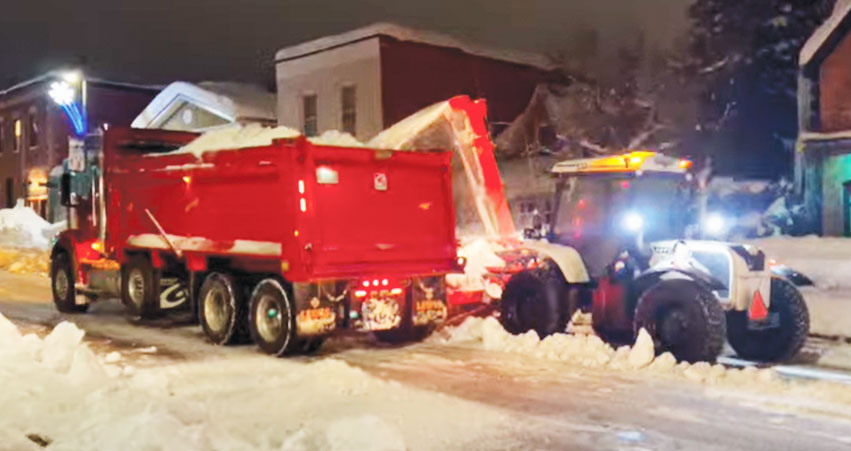
Municipal operations are under increasing pressure to maintain service levels with limited budgets and constrained labor resources. Roads must be cleared, public spaces maintained, and infrastructure supported — often with fewer operators and tighter financial controls.
In this environment, efficiency is no longer optional.
Municipalities need equipment that allows them to do more work with fewer resources.
The Better 175 is a European-engineered, productivity-first tractor designed to increase output per operator, compress fleet size, and support scalable municipal operations without increasing labor.
It is not simply a replacement for existing equipment — it is a different approach to how municipal work gets done.
From Multiple Machines to One Platform
Traditional municipal fleets rely on multiple specialized machines for seasonal work.
Snow removal, mowing, hauling, and maintenance are often handled by separate units — increasing fleet size, maintenance requirements, and operational complexity.
The Better 175 is designed as a multi-role platform capable of performing these functions with a single machine.
This allows municipalities to reduce equipment redundancy while increasing utilization throughout the year.
Increasing Output Per Operator
Labor availability is one of the biggest constraints facing public works departments.
The Better 175 improves operator capability through its bidirectional design and reversible operator station, allowing operators to face the working implement directly.
This improves visibility, control, and precision across applications such as snow removal, roadside maintenance, and groundskeeping.
When operators can work more efficiently, overall output increases without adding staff.
Efficiency in Real Municipal Environments
Municipal work takes place in complex environments — urban streets, cul-de-sacs, parks, and rural roadways.
The Better 175 integrates four steering modes and a rear axle swivel, allowing operators to maneuver efficiently in confined or irregular spaces.
This reduces repositioning, shortens task completion time, and improves workflow efficiency across multiple applications.
Year-Round Operational Continuity
Municipal equipment must remain productive across all seasons.
The Better 175 transitions seamlessly between winter, summer, and shoulder-season work — from snow removal to mowing and infrastructure maintenance.
This ensures consistent utilization and reduces the need for idle equipment.
Supporting Budget Efficiency
Municipal budgets require long-term cost control.
By replacing multiple machines with a single platform, the Better 175 reduces capital expenditure, maintenance costs, and fleet management complexity.
Fewer machines also mean lower fuel consumption, simplified servicing, and reduced storage requirements.
Reliable Performance and Serviceability
Public works operations depend on equipment reliability.
The Better 175 is built with serviceability in mind, offering accessible components and a modular design that simplifies maintenance.
Ongoing parts availability and dealer support ensure long-term operational continuity.
Operator Performance and Safety
Municipal operators work long hours in varying conditions.
The Better 175’s climate-controlled cab, suspension seating, and intuitive controls allow operators to maintain performance and focus throughout extended shifts.
Improved visibility in both directions enhances safety when working in public environments.
Designed for Ontario Municipal Conditions
Ontario municipalities operate across diverse environments, from dense urban centers to rural road networks.
The Better 175 is designed to perform across these conditions, maintaining efficiency and control regardless of terrain or season.
Its Tier 5 engine supports modern environmental standards while maintaining fuel efficiency.
Final Perspective
The Better 175 is not simply a tractor for municipal use.
It is a productivity platform designed to help municipalities do more with fewer resources.
By increasing output per operator and reducing fleet dependency, it supports a more efficient and scalable approach to public works operations.
To see how this fits into a complete municipal operation, explore our Industries - Municipalities page.